The US Pirate Party is a serious, principled political movement — fighting for digital rights, civil liberties, and human freedom in an era when all three face systematic assault.
We don't hide behind jargon. Here is what we actually believe — and why it matters.
The government has no business in your inbox, your browser history, or your phone. Mass surveillance programs eliminate the private space where dissent, creativity, and ordinary life happen. We support strong encryption as a right, warrant requirements for all digital searches, and the dismantling of bulk data collection programs.
Information should be free. We believe in a robust public domain, copyright terms that serve creators rather than corporations, and net neutrality as the foundational principle of the open internet. When knowledge is enclosed, only the powerful benefit.
Qualified immunity shields misconduct from accountability and must end. We support meaningful independent oversight, demilitarization of police departments, and abolishing civil asset forfeiture — the legal mechanism that allows property seizure from citizens who have never been convicted of anything.
The war on drugs has always been a war on people — disproportionately poor people and people of color. We support full decriminalization of personal drug use, release of nonviolent drug offenders, and regulated markets that end the violence inherent in prohibition.
Open government is accountable government. Closed government is corruption waiting to happen. We support strengthened FOIA laws with real enforcement, mandatory disclosure for all political spending, and robust protection for whistleblowers who expose wrongdoing.
No government has legitimate authority over the medical decisions of its citizens. Your body belongs to you — and that principle does not have exceptions based on who you are. Abortion rights, transgender healthcare, and gender-affirming care are not political positions. They are the direct application of bodily autonomy to real human lives. We support full reproductive freedom and the right of every person to make decisions about their own body and identity without restriction, interference, or apology.
We approach the Second Amendment as civil libertarians who believe in the right to bear arms and the responsibility to prevent preventable harm. We support responsible gun ownership alongside meaningful reform — and we refuse to pretend these positions are incompatible.
"The hat is the provocation. The platform is the point." 🏴☠️ US Pirate Party
"The name was chosen to take it back. Pirates have always been what power calls people who refuse to play by power's rules."
The first Pirate Party was founded in Sweden in 2006 — not as a joke, but as a direct response to aggressive copyright enforcement that was criminalizing teenagers for sharing music files. The name was chosen deliberately: to reclaim the word from the industry that weaponized it.
Pirate Parties have since won seats in the European Parliament, governed in Iceland, and built a global alliance operating across more than 40 countries. This is not a gimmick with unexpected longevity. This is a political movement that was serious from the beginning.
Historically, pirates operated outside the established order — creating their own systems of governance that were, remarkably, more democratic and egalitarian than the empires they sailed against. They were free people who rejected the enclosure of the commons by kings and merchants. The parallel to the digital era is not accidental.
We keep the name because it still works. It provokes. It makes people look twice. And once they look — the platform does the rest.
The two-party system is not a law of nature. It is the result of structural choices — first-past-the-post voting, ballot access barriers, and the billions of dollars that flow exclusively to two brands. Third parties exist not because they expect to instantly outspend that infrastructure, but because someone has to demonstrate what real political pluralism looks like.
The US Pirate Party operates within a broader coalition of allied parties united by a shared commitment to democratic reform, civil liberties, and the understanding that the current duopoly has catastrophically failed the American public.
The USTP alliance brings together parties with a common conviction: the path to electoral reform runs through building credible alternatives, winning local and state races, and changing what voters believe is possible.
Internationally, Pirate Parties have demonstrated that this model works. Iceland's Pirate Party governed. Germany's Pirates won parliamentary seats. Czech Pirates built coalition power. The playbook exists. We are executing it.
The question is not whether third parties can win. The question is whether enough people are willing to vote like they actually believe something different is possible.
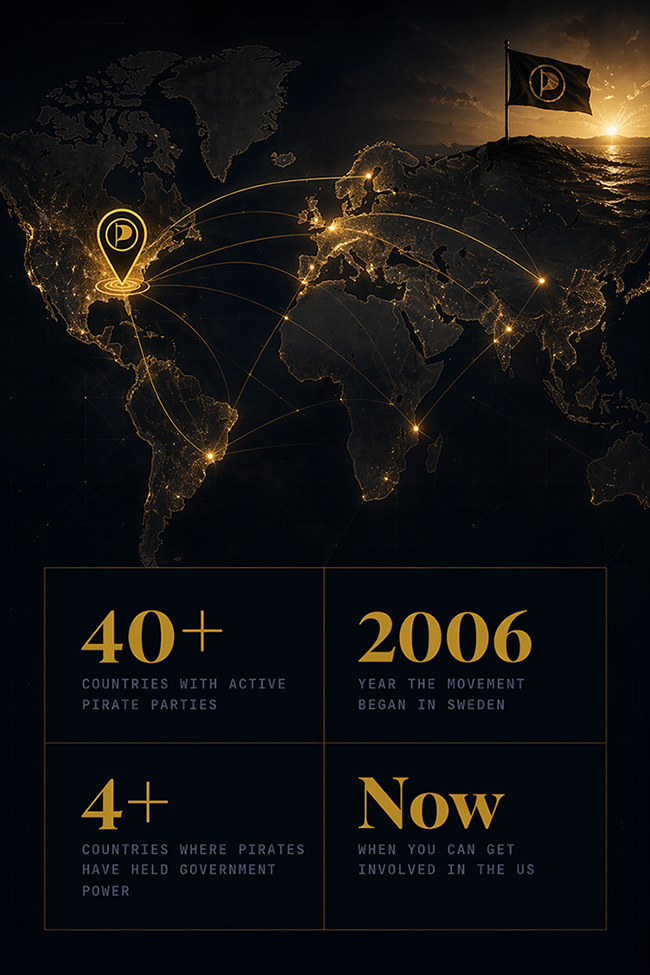
Third parties grow when people stop waiting for permission to vote for what they actually believe. If digital rights matter to you — if civil liberties matter to you — if the two-party status quo has failed you, there is a place for you here.
🏴☠️ The water is warm.
I did not come to the Pirate Party because the name was clever. I came because I was looking for a place where principles could become action, where freedom was not treated as a slogan, and where people were willing to do the work in front of them.
My pull toward this movement is personal. I believe a better society is built from the bottom up, not handed down from people waiting for permission. You build it by showing up, by listening, by helping where help is needed, and by touching one heart and one mind at a time until the culture around you starts to change.
That is what drew me here: the possibility of a party that does not just describe a freer world, but practices one. A movement brave enough to defend digital rights, civil liberties, bodily autonomy, and human dignity while still remembering that every platform point begins with real people trying to live.
— Catie